
Artless
On Lily Allen, Taylor Swift, and the problem of immediacy

When I was around 14 or 15, I wrote a song that was mostly about a former friend who’d been cruel to me in that vicious manner peculiar to teenage girls – and proceeded to perform it at the school talent show. For the couple of weeks following the show, the ex-friend in question would quote snatches of the lyrics to her new mates whenever she could see I was within earshot. I was briefly overcome with guilt and pictured police marching into our all-girls secondary and marching me out for the crime of ‘writing a mean song about someone’.
Now of course, I feel differently, and I would strongly advise against quoting the lyrics of a mean-spirited song back at its writer.
They will only take it as a massive compliment.
It’s been a long time since I’ve seen a post on social media that’s animated me enough to want to write about it, but thanks must go to Marie Le Conte (of whose writing I am a huge fan) for a take that caused me genuine relief when I read it:
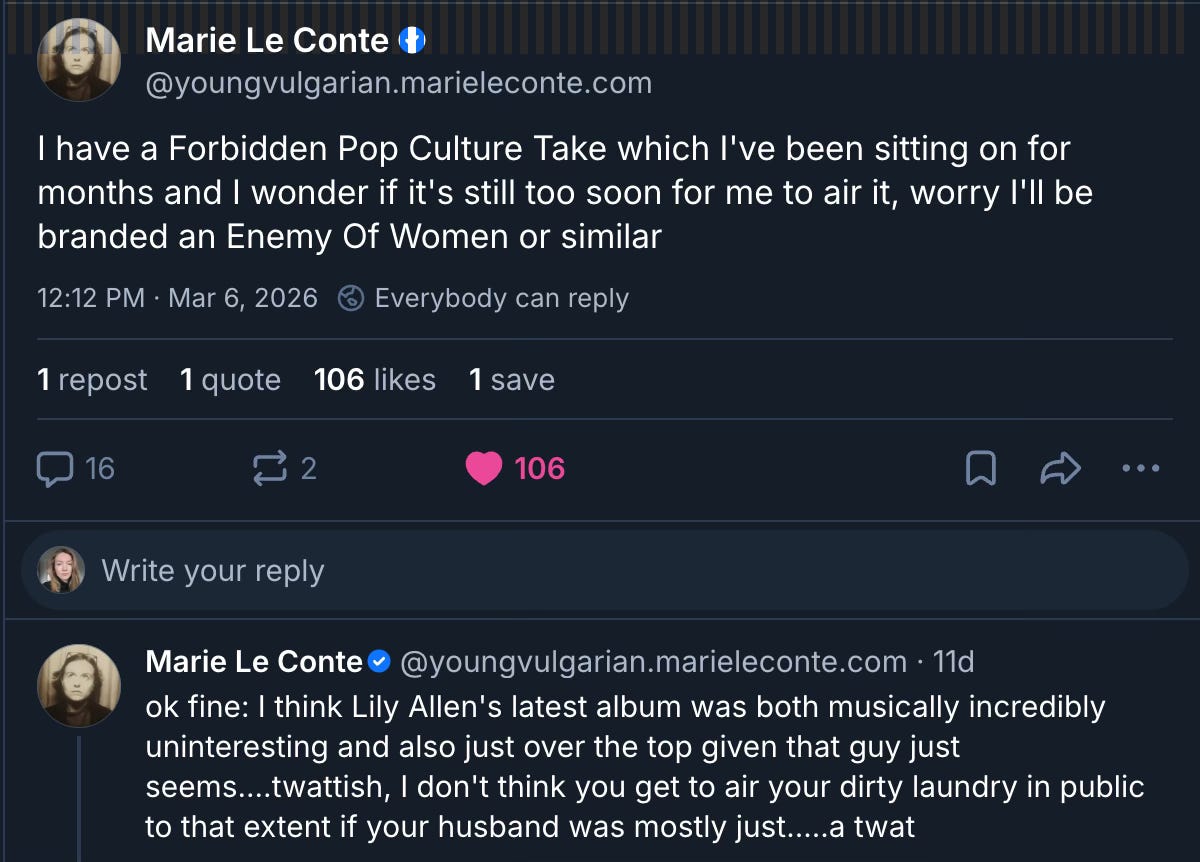
Because I’d felt similarly when West End Girl arrived a few months ago amid a barrage of inescapable hype. Don’t get me wrong: I grew up on music fuelled by female anger: Alanis Morissette, Tori Amos, Sheryl Crow, Thea Gilmore. A furious, scorched-earth break-up album is, in theory, pure catnip to me.
But the repeated praise for West End Girl’s rawness – how unfiltered it was, how Allen’s estranged husband and apparent subject of the record David Harbour must be dying of shame – simply made it sound like a set of diary entries or therapy sessions set to music. “[Not] so much a character assassination as a drive-by shooting” was how Clash put it, and I couldn’t summon any enthusiasm for something that sounded so, well, artless.
But while I’m with Le Conte in that West End Girl held no interest for me, I don’t agree about the ‘dirty laundry’ bit and I’ll defend to the death Lily Allen’s right to make records like it. There is nothing inherently nor artistically wrong with a song – or indeed, entire album – that excoriates someone who behaved poorly. Musicians write songs about things that have happened to them; that’s how creativity works. I subscribe to the Anne Lamott school of thinking: ‘if people wanted you to write warmly about them, they should’ve behaved better.’
So often, women’s art is presumed to be purely autobiographical – unedited diary entries sent out into the world. The terminally online among you may recall the ‘Do I hate my husband?’ piece that went briefly viral a few winters back. It was an extract from Heather Havrilesky’s (Ask Polly) highly entertaining memoir about her marriage, Foreverland – but readers of the New York Times piece did not seem to get that, and thought a woman was essentially abusing her husband in print for all to see. (Seriously, google ‘Heather Havrilesky hates her husband’ and see what you get.) Anyone with an ounce of intelligence can detect the hyperbole of the piece; I don’t think you have to be especially familiar with Havrilesky’s body of work to realise that this is her style, this is just what she does. But we seem to be losing the ability to distinguish between the ‘I’ of a narrator of a piece of work and the ‘I’ of its writer, and so everyone took her literally and duly condemned her.
What this amounts to is a denial of craft. And as I said, it happens to women’s art all the time. Remember when Taylor Swift’s The Life Of A Showgirl came out and everyone decided ‘Actually Romantic’ was a diss track aimed at Charli xcx and decried Swift for it? It made the BBC website, for God’s sake. What’s infuriating about this is that Swift is a professional songwriter who’s been delivering pop hits for the best part of two decades. Turning out a catty little number with lyrics that sound like they’ve been torn straight from the pages of a teenager’s diary is her literal job. You’re entitled to dislike the song, to wish it were smarter or more self-aware or whatever, but to condemn it as a factual statement of her feelings about someone is absurd.
If nothing else, it’s just wildly presumptuous to claim you know what any song is actually about, unless you were in the room when it was written. Very often what inspires a piece of work is not what it ends up being about – ask any creative. I happen to think it was one of the more enjoyable songs on an album that was sluggish with placeholder lyrics and light on Swift’s usual missile-precision writing. With its stolen Pixies chord progression and shout-along chorus, you could kind of imagine it being an Avril Lavigne album track circa 2005. But Swift was accused of ‘punching down’ and the song seems to be regarded as an embarrassment for her.
It’s worth saying at this juncture that Swift has undoubtedly cultivated and capitalised on a parasocial relationship with her fans. And the closing of the gap between artist and audience – thanks to the internet in general and social media in particular – means we can track celebrities’ romances and heartbreaks, map their lyrics onto events in their personal lives – and always, always assume we’ve got it right. Celebrities like Swift and Allen haven’t discouraged fans from playing this game; they benefit from it. But I don’t think we should let ourselves off the hook entirely. We should be smarter at thinking critically about the art and pop culture we consume. We should be able to distinguish between the narrator of a piece and its creator.
Unsurprisingly, Swift cropped up in the comments below Le Conte’s post, with more than one person expressing disapproval at her tendency to ‘re-litigate her past relationships in her songs’. Again, given that it’s pop music we’re talking about, rather than police witness statements, I’m always unsure as to why she shouldn’t write about her exes in a less than flattering way. Even if a song is spiteful, petty, cruel, unfair, unwarranted, unreasonable: those are still valid things for a song to be. Since when did songs have to be fair, reasonable, measured, even-handed? To demand that art has a moral framework you agree with is bizarre.
And even if you think a song’s lyrics are actually defamatory, well, it’s not easy to prove in a way that would have legal consequences. Following 2024’s infamous beef in which Drake was roundly destroyed by Kendrick Lamar, Drake accused Universal Music Group of ‘damaging his reputation by distributing and promoting “Not Like Us”’. The judge threw the case out on the grounds that ‘the lyrics expressed “non-actionable opinion” and therefore cannot be considered defamatory’1. You may not need reminding, but just in case: in ‘Not Like Us’, Kendrick accuses Drake of being a paedophile. Rap battles certainly have their own set of rules and expectations – something the judge in this case took into account – but the point stands. A song should not be taken as a literal statement of the artist’s opinion.
So, how did we get here? How did we lose the ability to distinguish between narrators and authors, the views in the art and the views of the artist?
American academic Anna Kornbluh2 has, I think, an answer for this. She calls it ‘immediacy’: a mode of producing works of art and culture where there is ‘a cutting out of anything that would require time to interpret instead of rapid uptake, a cutting out of any confusion or ambiguity’3. Kornbluh embeds the idea within a wider social, political and economic context we can broadly call the ‘Amazon Prime-ification’ of literally everything. We want something, we can have it within 24 hours. But in terms of art and culture, immediacy is a style in which ‘everything flickers good or bad, relatable or hateable; the grey falls away’. It’s Fleabag talking directly to the camera, it’s the explosion of memoir as a genre, it’s the way first-person narration has overtaken third-person narration in particular genres of fiction4. The art requires no work of processing to be done; meaning is never anything other than totally accessible. There is no need for deeper analysis or thinking or wondering, no space for ambivalence or uncertainty. Autofiction dominates; the ‘I’ of the narrator is, or may as well be, the ‘I’ of the writer.
And so if everything either is or is implied to be autofictional, diaristic, literal not figurative, then is it any wonder we receive every piece of art, pop culture or writing as a factual statement about the creator’s life, ‘the beginning of a conversation’5 , or worst of all, a mystery to be solved? The ‘I’ of the narrator can never be anything but the ‘I’ of the writer.
There’s an old saying about memoir and autobiographical writing: ‘don’t write breaking news’. In other words, wait until you’ve got some time and distance from events in your own life before you write about them. In the event of an enormous, illusion-shattering break-up, it usually takes a while before you can be truly honest with yourself about what happened. Creating and releasing art while still in the midst of the pain risks partial honesty; honesty up to a point and no further. And so to return to West End Girl: Allen’s record was lauded for being ‘candid and cathartic’, but when it looks like you simply want your audience to agree that a man who did bad things to you is bad, it’s less an album and more a leaked therapy session.
The confessional mode used to feel radical, electrifying. Alanis spitting ‘and are you thinking of me when you fuck her?’ Tori singing quietly, haunted as a church: ‘I wore a slinky red thing, does that mean I should spread / For you, your friends, your father, Mr Ed?’ The honesty of those lines pinned me to the floor when I first heard them. And that rawness still has its place; it can still feel radical and electrifying. But it can’t be all we get, it can’t be the only mode we consume.
I still want some artistry in my art.
https://www.theguardian.com/music/2025/oct/09/drakes-defamation-lawsuit-dismissed
My husband would like you to know that as an art historian and reader of critical theory and philosophy, he is the one who put me on to Anna Kornbluh
https://lit.newcity.com/2025/02/27/immediacy-one-year-later-a-conversation-with-anna-kornbluh/
Data on this is anecdotal but romance and YA seem to be the genres where it’s happening most noticeably. Slate had a good piece on it recently: https://archive.is/20260308143317/https://slate.com/culture/2026/03/romance-books-novels-fantasy-romantasy-booktok-pov-first-person-third-person.html
https://www.damemagazine.com/2022/01/07/have-we-forgotten-how-to-read-critically/